A newspaper report demonstrating the variation of sporting events that took place at Robertstown Sports and those who organised and participated on the day.
Kildare Observer and Eastern Counties Advertiser, 27 June 1908.
Text version of article
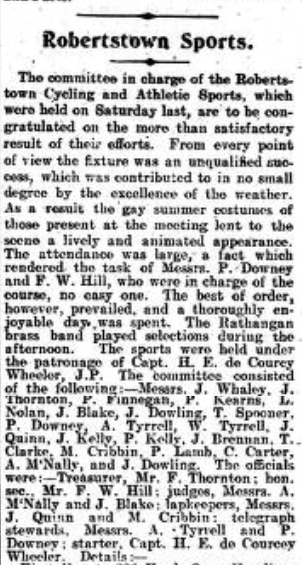
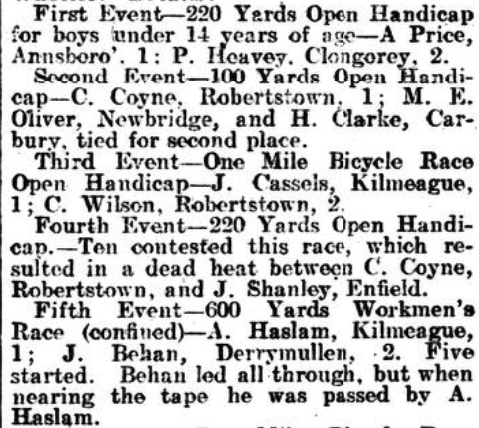
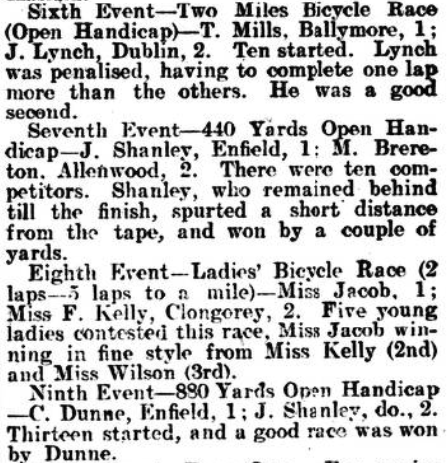
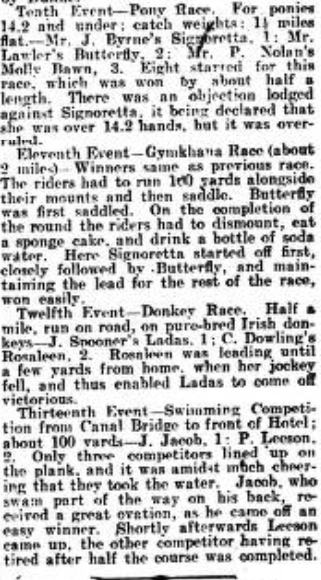
Robertstown Sports. The committee in charge of the Robertstown Cycling and Athletic Sports, which wore held on Saturday last, are to he congratulated the more than satisfactory result of their efforts. From every point of view the fixture was an unqualified success, which was contributed to in small degree the excellence tho weather. As a result the gay summer costumes of those present at the meeting lent to the scene a lively and animated appearance. The attendance was large, fact which rendered tho task of Messrs. P. Downey and F. W. Hill, who were in charge of the course, no easy one. The best order, however, prevailed, and a thoroughly enjoyable day.,was spent. The Rathangan brass band played selections during the afternoon. The sports were held under the patronage of Cpt. H. E. Courcy Wheeler, J.P. The committee consisted of the following:—Messrs. J. Whaley, J. Thornton, P, Finnegan, P. Kearns, L. Nolan, J. Blake, J. Dowling, T. Spooner, P. Downey, A. Tyrrell, W. Tyrrell, J. Quinn, J. Kelly, P, Kelly. J. Brennan, T. Clarke, M. Cribbin, P. Lamb, C. Carter, A. M’Nally, and J. Dowling. The officials were;—Treasurer, Mr. F. Thornton ; bon. sec.. Mr, F. W. Hill; judges, Messrs. A. and J. Blake; Lapkeepers, Messrs. J. Quinn and M. Cribbin: telegraph stewards, Messrs. A, • Tyrrell and P. Downey; starter, Capt. H. B. Wheeler. Details:— First Event—220 Yards Open Handicap for boys under 14 years of ago—A Price, Annsboro’. 1: P. Heavey, Clongorey, 2. Second Event—l00 Yards Open Handicap—C. Coyne, Robertstown. 1; M. K. Oliver, Newbridge, and H. Clarke, Carbary, tied for second place. Third Event—One Mile Bicycle Race Open Handicap—J. Cassels, Kilmeague, 1; C. Wilson. Robertstown, 2. Fourth Event—220 Yards Open Handicap.—Ten contested this race, which resulted in a dead heat between C. Coyne, Robertstown, and J. Shanley, Enfield. Fifth Event—600 Yards Workmen’s Race (confined) —A. Haslam, Kilmeague, 1; J. Behan, Derrymullen, 2. Five started. Behan led all through, but when nearing the tape was passed A. Haslam. Sixth Event—Two Miles Bicycle Race (Open Handicap)—T. Mills, Ballymore, 1; J. Lynch, Dublin, 2. Ten started. Lynch was penalised, having to complete one lap more than the others. He was a good second. Seventh Event—440 Yards Open Handicap—J. Shanley, Enfield, 1: 51. Brereton. Allefiwood, 2. There were ten competitors. Shanley, who remained behind till the finish, spurted short’ distance from the tape, and won by a couple yards. Eighth Event—Ladies’ Bicycle Race laps to mile) —Miss Jacob, 1; Miss F. Kelly, Clongorey, 2. Five young ladies contested this race. Miss Jacob winning in fine style from Miss Kelly (2nd) and Miss Wilson (3rdl. Ninth Event—880 Yards Open Handicap —C. Dunne, Enfield, 1; J. Shanley, do., 2. Thirteen started, and good race was won Dunne. „ Tenth Event—Pony flare. For ponies 14.2 and under; catch weights: miles flat.—Mr. J. Bvrne’s Signoretta. 1: Mr. Lawler’s Butterfly. 2: Mr. P. Nolan’s Molly Bawn, 3. Eight starred for this race, which was won about half a length. There was an object ion lodged against Signoretta. it being declared that she was over 14.2 hands, but it was over- Eleventh Event—Gymkhana Race (about 2 miles! – Winners same previous race. The riders had to W 0 yards alongside their mounts and then saddle. Butterfly was first saddled. On the completion the round the riders had to dismount, eat a sponge cake, and drink a bottle soda water. Here Signoretta started oft first, closely followed -Butterfly, and maintaining the lead for the rest of the race, won easily. . Twelfth Event—Donkey Race. Half a mile, run on road, pure-bred Irish donkevs-J. Spooner’s Ladas. 1; C. Dowling Rosaleen. 2. Rosaleen was leading until a few vards from home, when her jockey fell, and thus enabled Ladas come off victorious. „ , . _ .. Thirteenth Event —Swimming Competition from Canal Bridge to front of Hotel; about 100 vards—J. Jacob, 1: P. Leeson, 2. Only three competitors lined the plank, and it was amidst much cheering that they took the water. Jacob, who swam part of the way his back, received a great ovation, as came off an winner. Shortly afterwards Lesson came up. the other competitor having retired after half the course was completed.
An alledged malicious burning in Robertstown.
Kildare Observer and Eastern Counties Advertiser, 4 April 1908.
Text of article
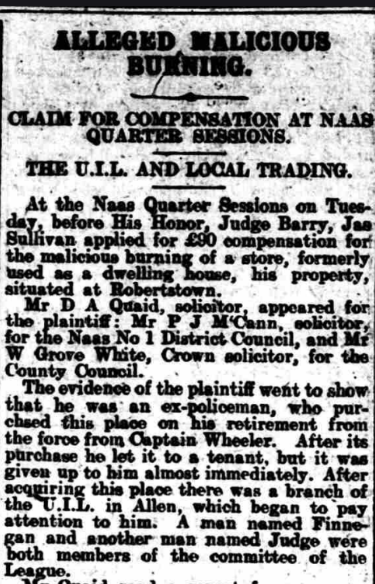
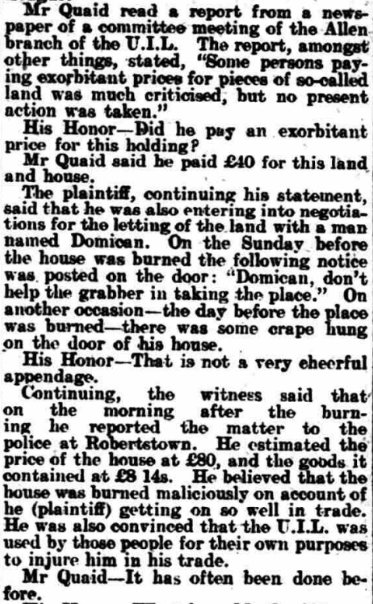
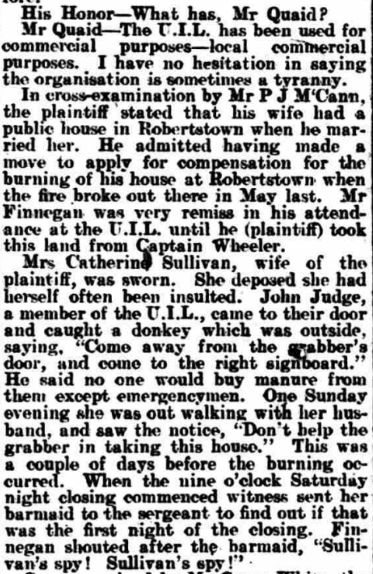
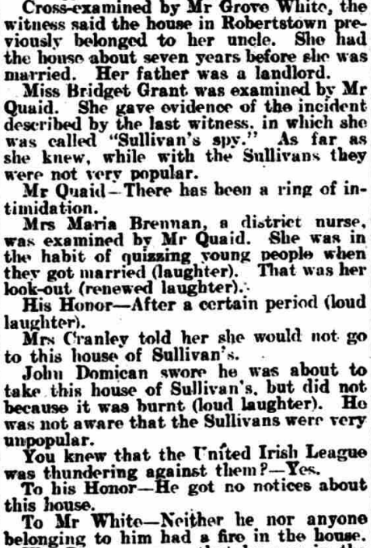
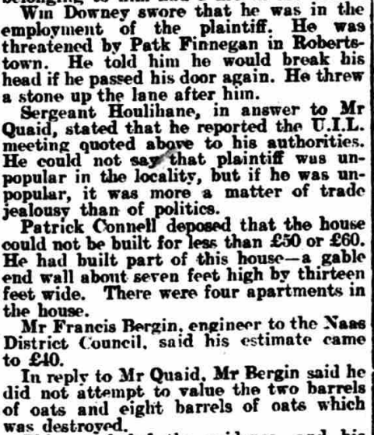
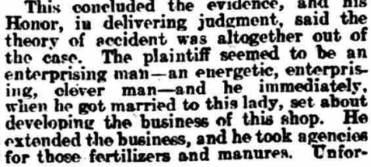
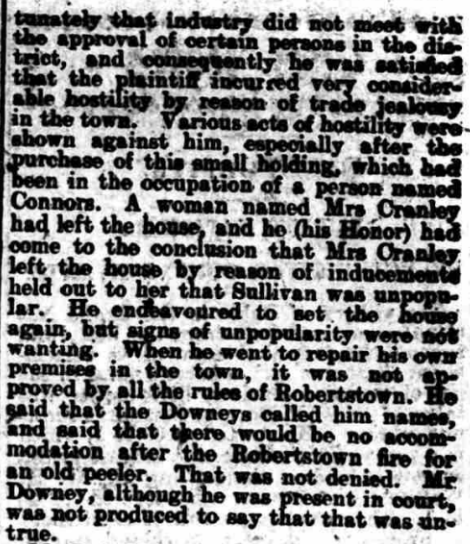
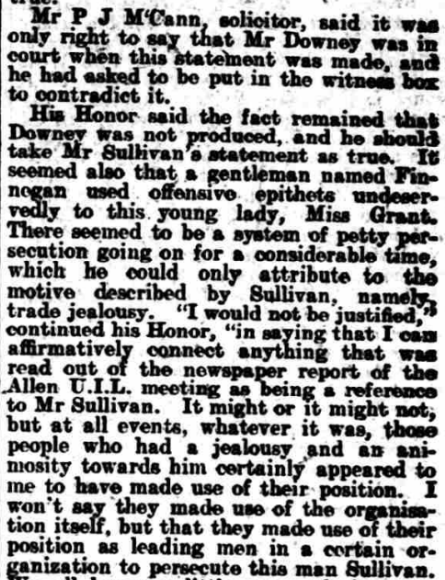
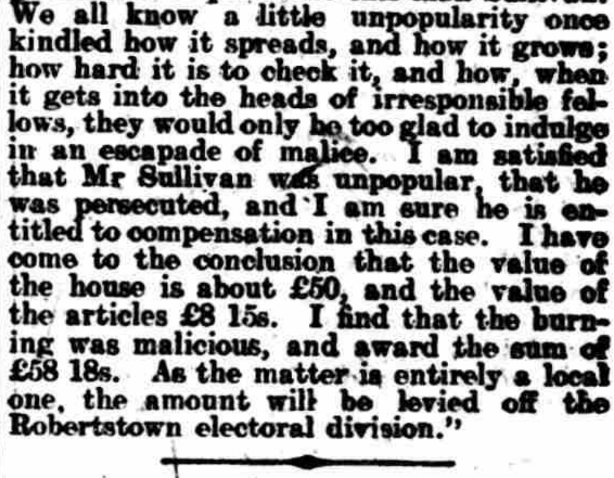
ALLEGED. MALICIOUS BURNING. CLAIM FOR COMPENSATION NAAS QUARTER SESSIONS. THE U.I.L. AND LOCAL TRADING. At the Naas Quarter Sessions Today, before his Honor, Judge Barry, Jas Sullivan applied for compensation for the malicious burning of store, formerly used as a dwelling bouse, his property, situated at Robertstown. Mr D A Quaid, solicitor, appeared for the plaintiff: Mr P J M’Cann, solicitor, for the Naas No 1 District Council, and Mr Grove White, solicitor, for the County Council. The evidence the plaintiff went to show that he was ex-policeman, who purchased this place on his retirement from the force from Captain Wheeler. After its purchase he let it to a tenant, but it was given up to him almost immediately. After acquiring the place there was a branch the U.I.L., in Allen, which began to pay attention to him. A man named Finnegan and another man named Judge were both members of the committee of the League. Mr Quaid read a report from a newspaper of a committee meeting of the Allen branch of the U.I.L. The report, amongst other things, stated, “Some persons paying exorbitant prices for pieces of so-called land was much criticised, but no present action was taken.” His Honor—Did he pay exorbitant price for this holding? Mr Quaid said he paid £4O for this land and house. The plaintiff, continuing his statement, said that he was also entering into negotiations for the letting of the land with man named Domican. On the Sunday before the house was burned the following notice was posted the door: ‘Domican, don’t help the grabber in taking the place.” On another occasion—the day before the place was burned—there was some crape hung on the door of his house. His Honor—That is not a cheerful appendage. Continuing, the witness said that on the morning after the burning he reported the matter to the police at Robertstown. He estimated the price of the house at £8O, and the goods contained at £8 14s. He believed that the house was burned maliciously on account of he (plaintiff) getting on so well in trade. He was also convinced that the U.I.L. was used those people for their own purposes to injure him in his trade. Mr Quaid —It has often been done before. His Honor—What has, Qnaid? Mr Quaid —The U.I.L. has been used for commercial purposes—local commercial purposes. _ I have no hesitation in saying the organisation is sometimes a tyranny. In cross-examination Mr P J M’Cann. the plaintiff stated that his wife had a public house in Robertstown when he married her. He admitted having made a move apply for compensation for the burning of the house at Robertstown when the fire broke out there in May last. Finnegan was very remiss in his attendance at the U.I.L. until he (plaintiff) took this land from Captain Wheeler. Mrs Catherine Sullivan, wife of the plaintiff, was sworn. She deposed she had herself often been insulted. John Judge, a member of the U.1.L., came to their door and caught a donkey which was outside, saying, “Come away from the grabber’s door, and come to the right signboard.” He said no one would buy manure from them except emergencymen. One Sunday evening she was out walking with her husband, and saw the notice, “Don’t help the grabber in taking this house.” This was a couple of days before the burning occurred, When the nine o’clock Saturday night closing commenced witness sent her barmaid to the sergeant to find out if that was the first night of the closing. Finnegan shouted alter the barmaid, “Sullivan’s spy! Sullivan’s spy!’’ ■ Cross-examined by Mr Grove White, the witness said the house in Robertstown previously belonged to her uncle. She had the house about seven years before she was married. Her father was a landlord. Miss Bridget Grant was examined, Mr Quaid. She gave evidence of the incident described by the last witness, in which she was called “Sullivan’s spy.” As far she knew, while with the Sullivans they were not very popular. Mr Quaid – There has been a ring of intimidation. Mrs Maria Brennan, district nurse, was examined Mr Quaid. She was in the habit of quizzing young people when they got married (laughter). That was her look-out (renewed laughter).; … His Honor—After a certain period (loud laughter). Mrs Cranley told her she would not to this house of Sullivan’s. John Domican swore he was about to take this house of Sullivan’s, but did not because it was burnt (loud laughter). He was not aware that the Sullivans were very unpopular. You knew that the United Irish League was thundering against them?—Yes. His Honor—He got no notices about this louse. To Mr White—Neither he nor anyone belonging to him had a fire in the house. Wm Downey swore that was in the employment of the plaintiff. He was threatened by Pat Finnegan Robertstown. He told him would break his head if he passed his door again. He threw a stone up the lane after him. Sergeant Houlihane, in answer to Mr Quaid, stated that he reported the U.I.L. meeting quoted above to his authorities. He could not say that plaintiff was unpopular in the locality, but if was unpopular, it was more a matter of trade jealousy than of politics. Patrick Connell deposed that the house could not built for less than £5O or £6O. had built part of this house— a gable end wall about seven feet high thirteen feet wide. There were four apartments in the house. , „ Mr Francis Bergin. engineer to the Naas District Council, said his estimate came to £40. In reply to Mr Quaid. Bergin said he did not attempt to value the two barrels oats and eight barrels of oats which was destroyed. ~ … This concluded the evidence, and his Honor, in delivering judgment, said the theory of accident was altogether out of the case. The plaintiff seemed to an enterprising man—an energetjc, enterprising, clever man —and be immediately, when got married to this lady, set about developing the business this shop. He extended the business, and took agencies for those fertilizers and manures. Unfortunately that industry did not meet with the approval of certain persons in the district. Consequently he was satisfied that the plaintiff incurred very considerable hostility by reason of trade jealousy in the town. Various acts of hostility were shown against him, especially after the purchase of this small holding, which had been in the occupation of a person named Connors. A woman named Mrs Cranley had left the house, and he (your honor) had come to the conclusion that Mrs Cranley left the house by reason of inducement held out to her that Sullivan was unpopular. He endeavoured to set the house again, but signs of unpopularity were not wanting. When went to repair his own premise in the town, it was not approved by all the rules of Robertstown. He said that the Downeys called him names, and said there would be no accommodation after the Robertstown fire for an old peeler. That was not denied. Mr Downey, although he was present in court was not produced to say that that wasn’t true. Mr P J M’Cann solicitor, said it was only right to say that Mr Downey was in court when this Statement was made, and he had asked to be put in the witness box to contradict it. His Honor said the fact remained that was not produced, and he should take Mr Sullivan’s statement as true. It seemed also that a gentleman named Finnegan used offensive epithets undeservedly to this young lady. Miss Grant. There seemed to be a system of petty persecution going on for a considerable time, which he could only attribute to the motive described by Sullivan, namely, trade jealousy. “I would not be justified.” continued his Honor, “in saying that I can affirmatively connect anything that wan read out of the newspaper report of the Allen U.I.L. meetiiig as being a reference to Sullivan. It might or it might not, but at all events, whatever it was, those people who had a jealousy and an animosity towards him certainly appeared to me to have made use of their position. 1 won’t say they made use of the organisation itself, but that they made use their position as leading men in certain organization to persecute this man Sullivan. We all know a little unpopularity once kindled how jt spreads, and how it grows, how hard it is to check it, and how, it gets into the heads of irresponsible fellows, they would only be too glad to indulge in an escapade of malice. I am satisfied that Mr Sullivan was unpopular, that he was persecuted, and l am sure he is entitled to compensation in this case. I have come to the conclusion that the value of the house is about £50, and the value of the articles £8 15s. I find that the burning was malicious, and award the sum of £58 18s. As the matter is entirely a local one, the amount will be levied off the Roberts town electoral division.
 Robertstown History of Family